The photographs featured in this article are from the collection of Christopher B. Steiner.
Christopher B. Steiner, Professor of Art History and Anthropology, as well as the Director of the Museum Studies Certificate Program at Connecticut College, recently curated a unique photography exhibit at the Lyman Art Museum. Photography and the Painted Image, “[explored] the intersection between photography and painting, highlighting the ways in which the two mediums have overlapped and complemented each other.”
The exhibit featured three distinct sections: the painted backdrop, the painted foreground, and the painted photograph. We’ll be looking at a few selections from the painted backdrop section.
As Steiner describes it in Photography and the Painted Image (an eBook published to accompany the exhibit—check it out here), painted backdrops were “a hallmark of nineteenth- and early twentieth-century portrait studios. These elaborate hand-painted scenes framed sitters within idealized interiors or imaginary landscapes.”
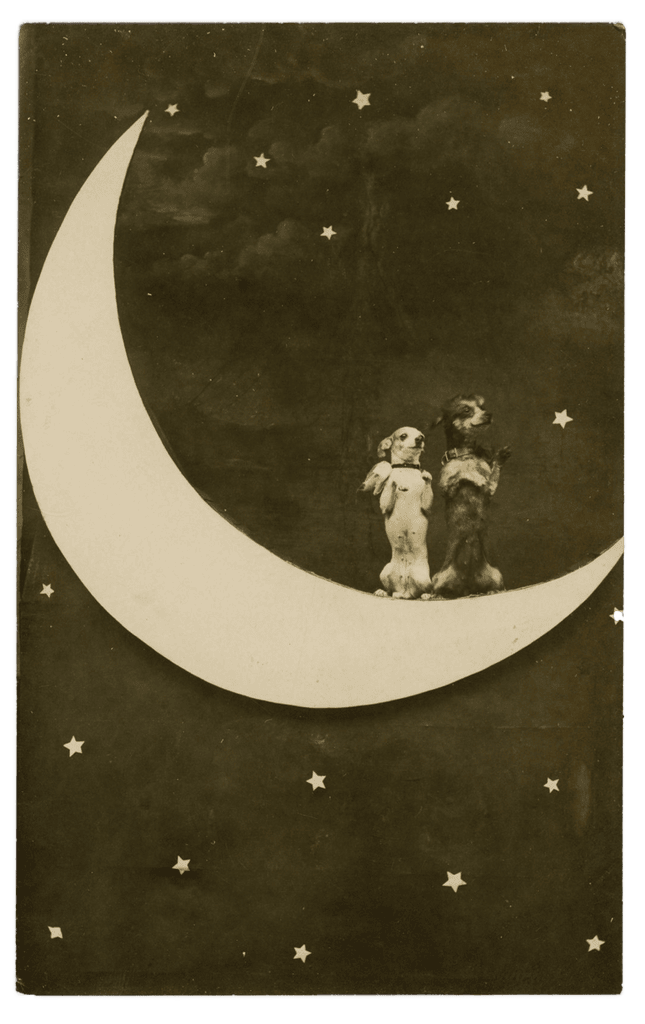
In this first image, two dogs pose on a prop crescent moon with starry night sky as the backdrop. Taken at Sunbeam Studio at Salisbury Beach in Massachusetts, the original is a real photo postcard (RPPC), which were photographic prints developed directly from negatives onto postcard stock. Many studios made painted backdrops specifically for RPPCs, “often reflecting popular trends and fantasies — such as […] sitting up in the night sky with the Man in the Moon.” Perhaps the dogs and their owner were on vacation at the beach, and thought to send this whimsical image to a relative back home.
Real photo postcard.
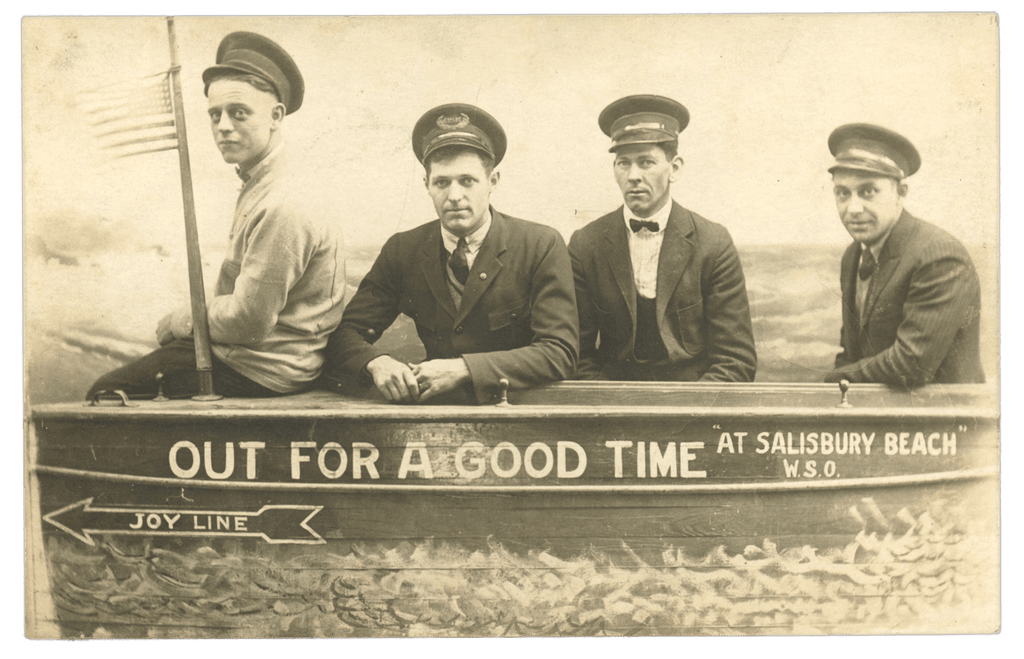
This image, also taken at Salisbury Beach, shows members of the Laconia Fire Department posing in a prop boat against an ocean backdrop. Seascapes and other seaside scenes made popular painted backdrops, “[transforming] the beach into an imagined spectacle shaped by studio illusion rather than direct encounters with the sea.” This is representative of a technical reality behind painted backdrops: because early photography required long exposures, the type of movement that naturally accompanies any live scene, especially the constant movement of the ocean, could lead to a blurry result.
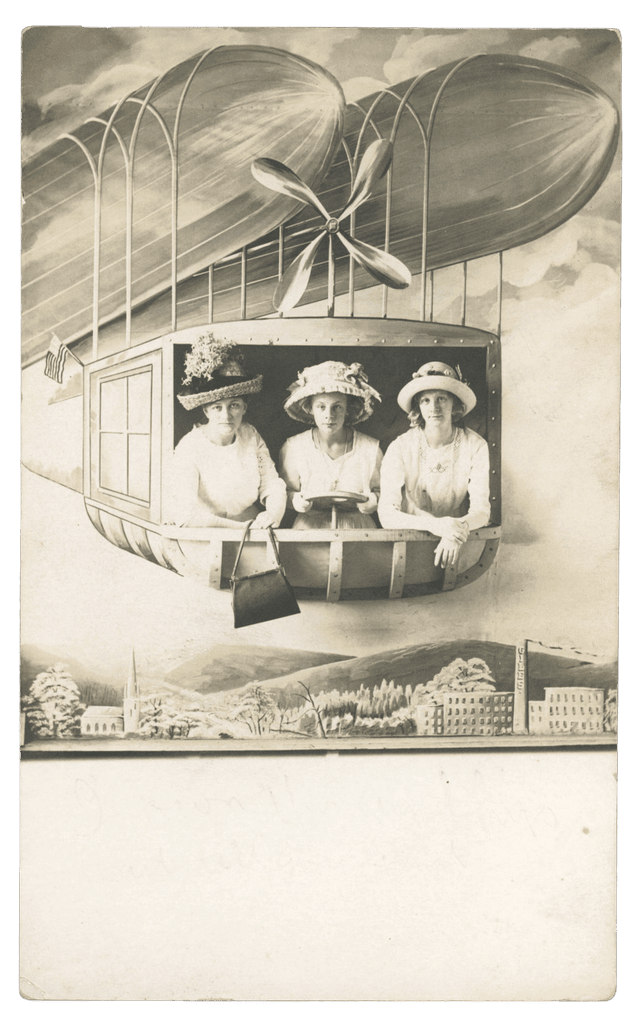
The Giles Studio, Waterbury, Connecticut, ca. 1910-15.
Real photo postcard.
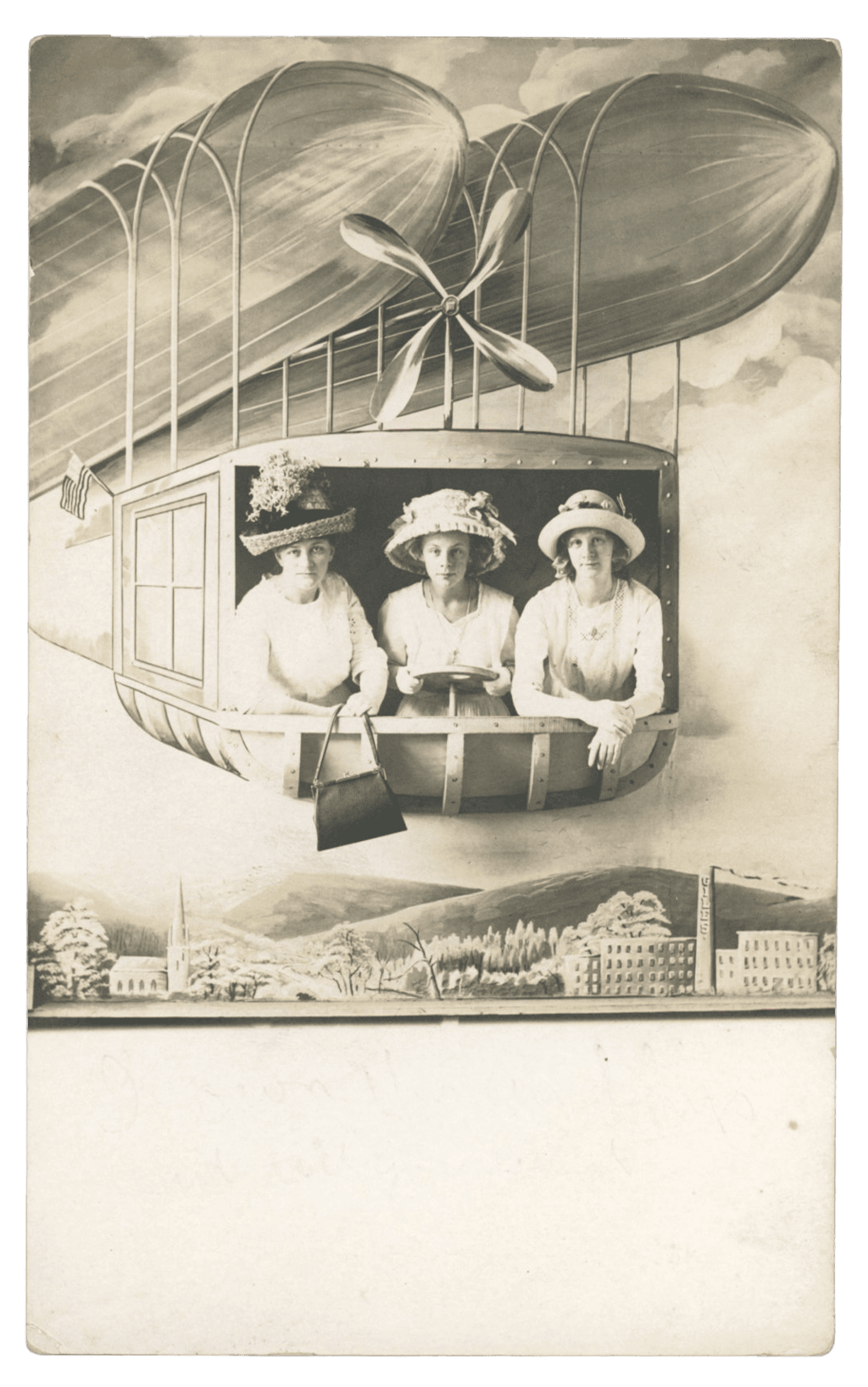
Painted backdrops and studio props also provided an opportunity for subjects to imagine themselves in scenes they might not otherwise find themselves in. For example, this photograph of three women posing in a prop airship was a chance to see themselves piloting such a craft. One of the women holds the steering wheel as if it’s real, showing how these realistic backdrops accompanied by convincing props “[invited] belief in the illusion and knowingly puncture it, turning staged artifice into visual wit.”
Taken together, these three images show how far a painted backdrop could stretch the truth of a moment: a pair of dogs on the moon, firefighters at sea without ever leaving the sand, women in a plane that went nowhere. The painted backdrop didn’t just frame a sitter— it let them briefly live somewhere, or as someone, they weren’t.
Sources:
Photography and the Painted Image by Christopher B. Steiner (2026), published in conjunction with the exhibition at the Lyman Allyn Art Museum. Read the full ebook here.
https://www.lymanallyn.org/photography-and-the-painted-image/
https://www.conncoll.edu/directories/faculty-profiles/christopher-steiner
https://en.wikipedia.org/wiki/Real_photo_postcard
What the heck…
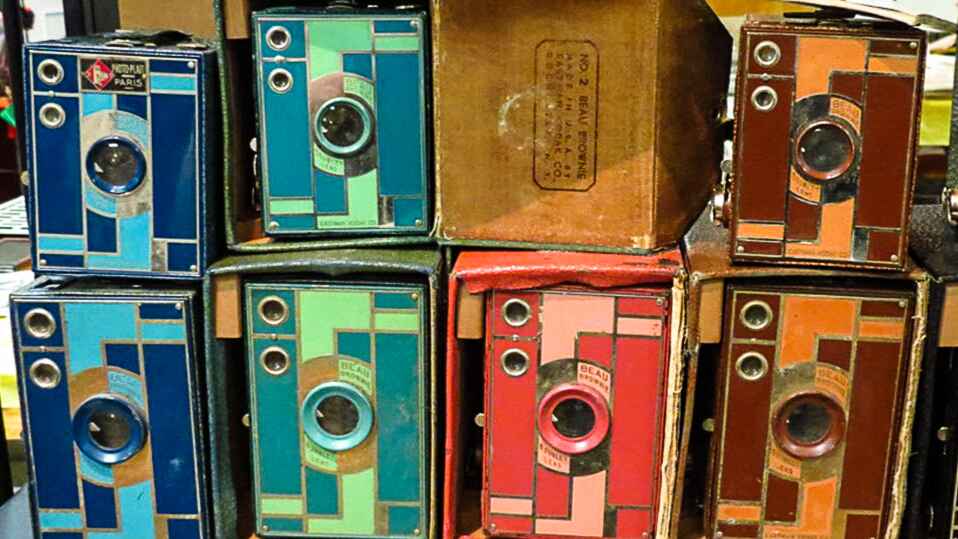
Are Those Even Cameras?!
Join the PHSNE Newsletter and learn more about photographic history and preservation. Already an expert? Come and share your collections and knowledge as we celebrate the history and advancement of photography.