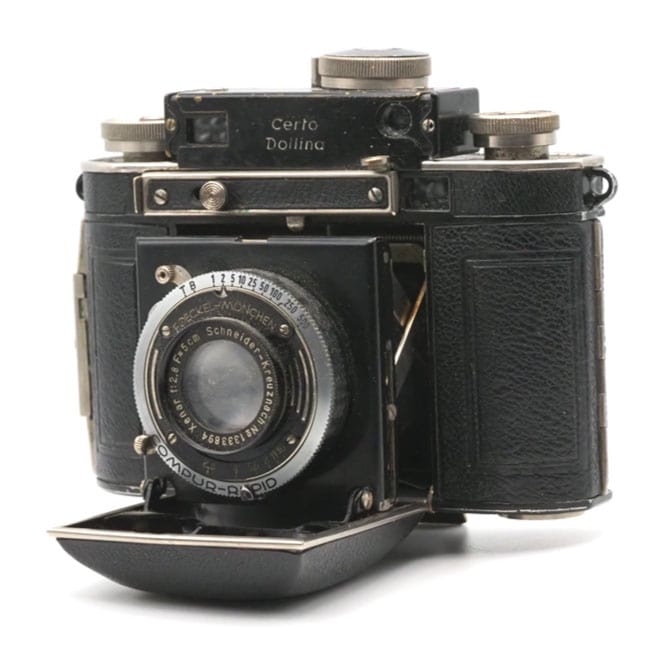
Introduced in 1935, the Dollina was the second camera to use Kodak’s 35mm film cartridges. When later Dollina models were produced, it became known as the Dollina I, sometimes referred to as the base model. It was a horizontal-bed folding 35mm camera with a simple viewfinder (but lacking a rangefinder) with the focus knob on the top.
Because the Dollina was the second camera designed to use 135 cartridges, (4th if you count the Leica and Contax, which originally used their own reloadable cartridges), the designers of later models were inventing things on the fly and made some choices that did not become the standard in other 35mm cameras. These include:
- Separate rangefinder and viewfinder windows. This follows the Leica design. A single, combined window did not become standard until the 1960s.
- Three teeth on the wheel that counts sprocket holes for the film counter. Practically all other 35mm cameras use six.
- To disengage the sprocket wheel to allow rewind, you pull up on the wind knob, rather than the more standard button on the bottom of the camera, or a switch on the top plate of the camera.
- To set the exposure counter to zero, you slide a lever to the left, and push a button to the left several times until it reads zero. You then slide the lever back to the right to prevent accidentally changing the counter. The same lever, pushed in a different direction is used to allow the film to advance and increment the exposure counter, just like on the later Argus C3.
- Like many contemporary roll-film cameras that didn’t need a mechanism to count exposures, the shutter reset is a lever near the lens.
- The hinge for the lens cover is at the bottom edge of the camera and the lens cover is fairly deep, so the lens cover sits below the bottom edge of the camera. This is seen in the photograph of the camera’s side. To allow the camera to sit flat on a flat surface, there is a fold-out hinge at the bottom-rear of the camera, the same width as the lens cover’s depth.
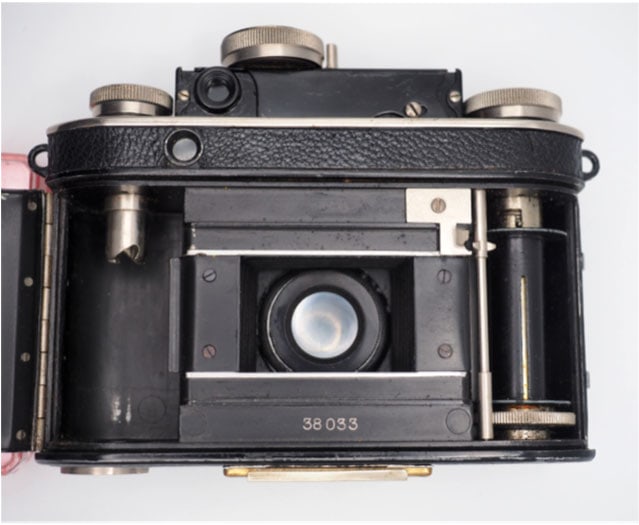
All photos on this page were taken by PHSNE President Larry Woods; they show various views of the Dollina II in his collection. Introduced in 1936, the Dollina II had a Compur Rapid shutter and high-end lens. Earlier models had a black finish, later models a chrome finish. Like the original Dollina, focusing relied on a knob at the top that moved a pair of struts. Selling just under $60, it was a mid-priced camera in its day. Also introduced in 1936 was the Dollina 0, a low-end alternative which featured 3-element lenses, simple shutters, and front cell focusing.
The high-end Dollina III had a coupled rangefinder integrated into a new baroque-shaped body. It had a short shelf life which is why it’s hard to find one. The final generation was the Super Dollina, introduced in 1939, and the Super Dollina II launched in 1951. The new body was more rounded and compact, more like the Dollina I and II; the viewfinder and rangefinder were separated. The Super Dollina was manufactured until WW II, and the Super Dollina II was produced after the war and manufactured until the early 1970s; it also sold as Super 35. One feature of the Super Dollina II was the slim advance and rewind buttons.
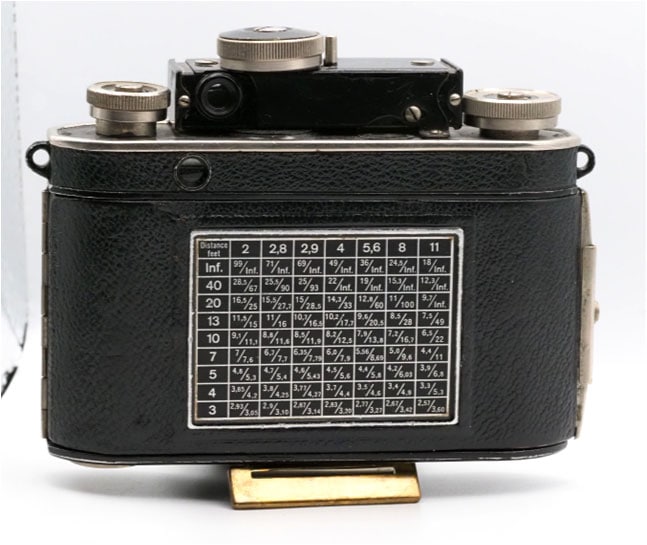
Certo, the Dresden-based manufacturer of the Dollina, did not have the international distribution that other German camera companies had, so it is not as well known in the US as other brands. Certo is mainly known here for 120 film folding cameras. They survived the war, but were located in East Germany. They were small enough to initially remain a private company, but ultimately became part of VEB Pentacon.
For more information about the Dollina models visit https://camerapedia.fandom.com/wiki/Dollina or https://camera-wiki.org/wiki/Dollina).
What the heck…
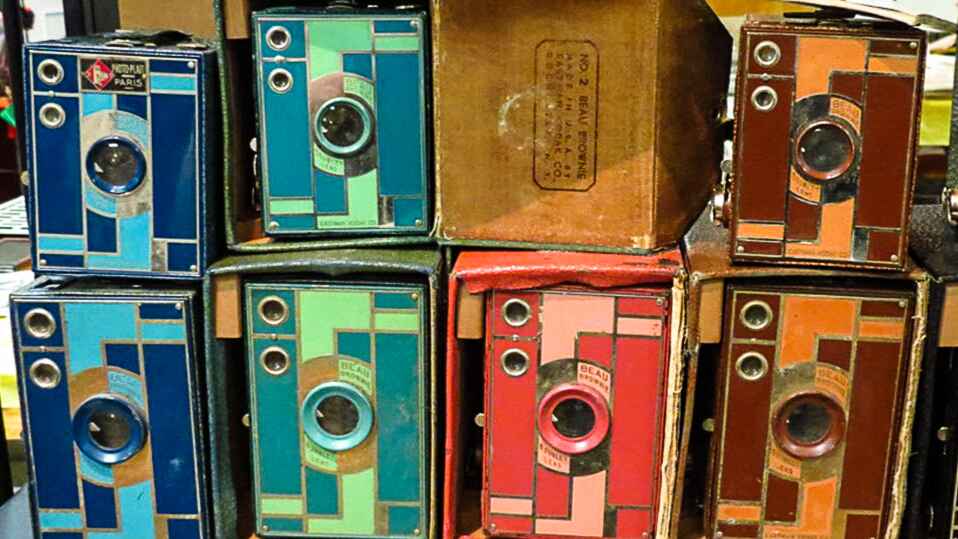
Are Those Even Cameras?!
Join the PHSNE Newsletter and learn more about photographic history and preservation. Already an expert? Come and share your collections and knowledge as we celebrate the history and advancement of photography.