Polaroid’s 20×24 and its Museum Camera were both introduced in 1976 to satisfy the “announced desires” of Edwin Land. The 20×24 was designed to “juice up the 1976 shareholders’ meeting” and the Museum Camera to obtain a life-size replica of a Renoir painting at Boston’s Museum of Fine Arts (https://www.harvardmagazine.com/2017/08/a-tale-of-two-cameras).
The Museum Camera was built at the MFA and housed there for a number of years. Building it on site eliminated the risky process of transporting the Renoir and subsequent paintings it was created to photograph. The camera boasted a 50 pound custom-made lens and film 44 inches wide which, when used with 80 inch high sheets, produced instant photos larger than a standard door.
Beside making high quality life-size copies of art works, the Museum Camera made it to The Guinness Book of Records with “the largest box camera ever constructed, a super-sized version . . . in order to photograph Raphael’s Transfiguration of Christ at the Vatican.”
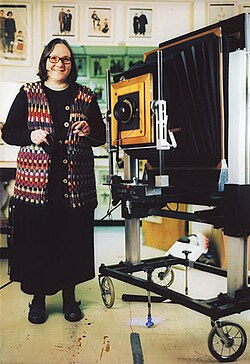
https://en.wikipedia.org/wiki/Elsa_Dorfman
The somewhat smaller, but still oversized, 20×24 was also used to photograph art works, but its purpose was less clear: “The 20×24 existed, and the company had to dream up its purpose after the fact. Today, it’s considered an artist’s tool. Back then, it was a product in search of a market.”
Wikipedia designates the 20×24 as “one of the largest format cameras currently in common use [that] could be hired from Polaroid agents in various countries” (https://en.wikipedia.org/wiki/Polaroid_20%C3%9724_camera). Its film plates measure 20×24 inches; however at least one camera can take 23×36 inch photographs. Like a field camera, the 20×24 can be collapsed and transported. “The bellows are compressed into the body, and the body lowers into its base.”
Very few were built initially, only six from 1976 to 1978. Famous photographers were given the opportunity to use them at the Polaroid studios if they allowed Polaroid to keep some of the images. Perhaps most widely-known is Cambridge, Massachusetts photographer Elsa Dorfman. The 20×24 self portrait, standing next to another 20×24 shown here, appeared in the September 2020 issue of snap shots as part of Dorfman’s obituary.
According to the Harvard Magazine article cited earlier, in 1978 Polaroid “constructed four [20×24] cameras, with plans for three more. But they cost about $50,000 apiece—before operating expenses. Polaroid determined that each camera should be serviced by two full-time staff members: a ‘back man’ who took care of the film supply, mechanics, and logistics, and a ‘front man’ devoted, essentially, to promotion. He’d be ‘the synthesis of a sound businessman and an excellent photographer’—someone who ‘knows who the photographers of importance are…convinces them to try using a 20×24, and guides them to having a very successful first experience.”
The 20×24 reappeared in 1997, built by former Polaroid employee John Reuter seventeen years after the 20×24 Studio was spun off from Polaroid and two decades after the appearance of the very few original models.
What the heck…
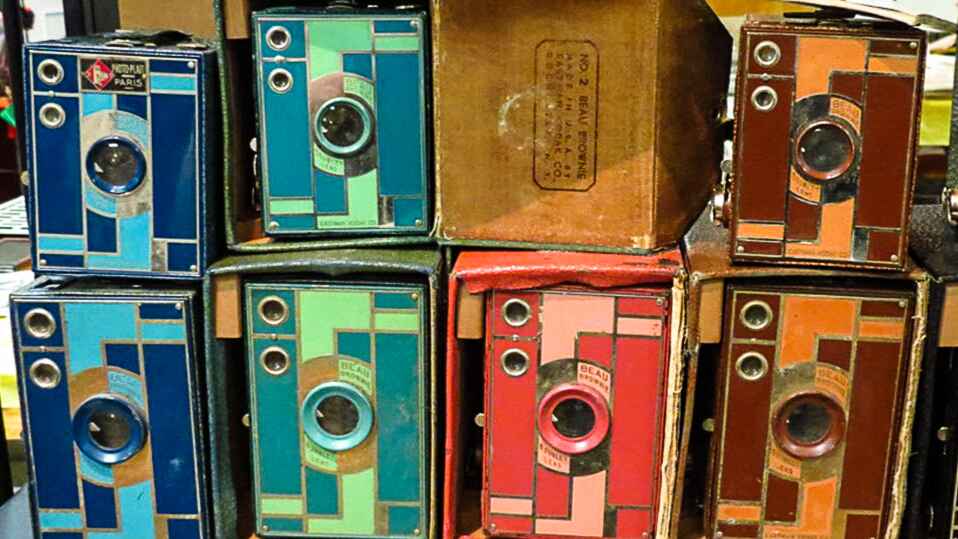
Are Those Even Cameras?!
Join the PHSNE Newsletter and learn more about photographic history and preservation. Already an expert? Come and share your collections and knowledge as we celebrate the history and advancement of photography.