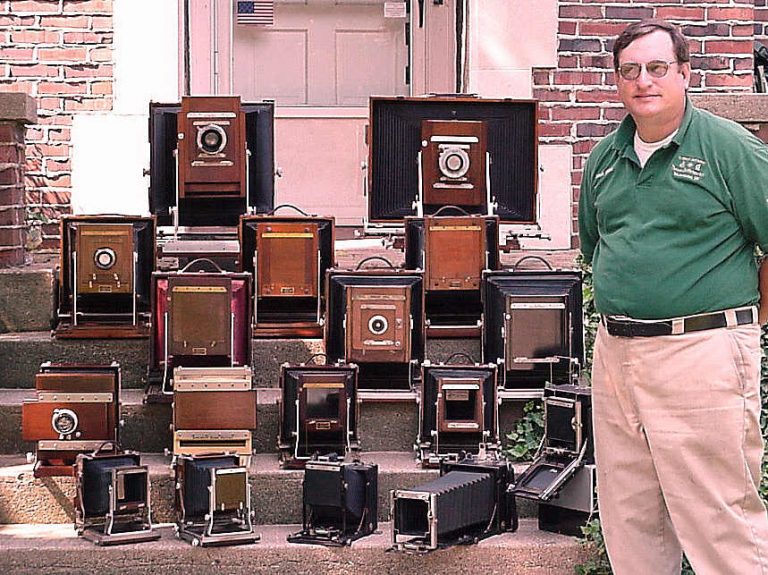
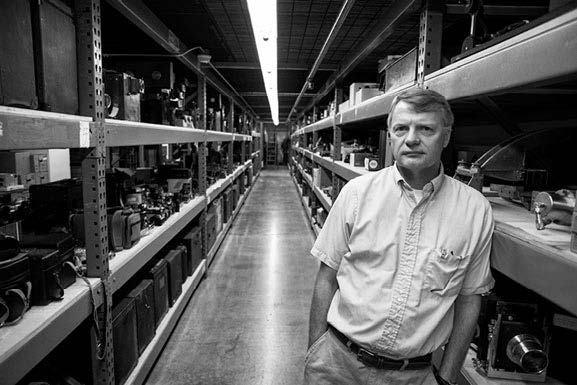
This meeting has passed and is now available as a recording! Todd Gustavson, Curator of Technology at George Eastman House in Rochester, New York, highlights the museum’s camera collection, documenting camera evolution.
The George Eastman Museum (founded as George Eastman House in 1947) is the oldest photography museum in the world. Its holdings of photographic technology—more than 22,000 objects—is the largest and most important collection of its kind. It was designated as an ASME (American Society of Mechanical Engineers) Historic Site in 2015.
The Technology Collection comprehensively represents the history of photographic cameras, from the 1839 introduction of photography to those from the current digital photography era. The collection was acquired from corporate donors such as the Eastman Kodak Company and Graflex, from hundreds of private donors, and directly or indirectly from well-known photographers such as Alfred Stieglitz and Walker Evans.
Eastman Kodak Company also established its own corporate museum, the Eastman Kodak Patent Collection, which consisted of a complete set of their cameras, most of which were acquired directly from the production line. And as the name implies, it was a collection largely used for legal purposes; it also included a fairly complete set of products manufactured by their competitors.
While the fundamentals of camera design have changed considerably over the last two hundred years (taking into account the Nicephore Niepce process), the concept of photography, the ability to capture and save images has not. Needless to say the photographic process has greatly changed from being an arduous picture-making process requiring specific equipment and the knowledge to use it. This began with the introduction of commercially manufactured gelatin dry plates, ca. 1880, then more so with the introduction of the handheld Kodak and its accompanying photo-finishing system in 1888 by George Eastman.
Twelve years later, Eastman introduced the Brownie camera which, with its $1.00 selling price, placed the camera in the hands of the ordinary person, without regard to skill or experience. By the twentieth century, the camera was a commonplace device at home, in a scientist’s laboratory, a portraitist’s studio, a director’s movie set, the photojournalist’s knapsack, and the car of a family on vacation.
Today, the camera and its related technologies continue to profoundly affect photography and its multitude of users. Replacing traditional film technology, new digital cameras constituted a radical change in the capture, output, and dissemination of images and informational content. In the innovative world of imaging, a widely used term distinguishing the progressive leap from an old to a new era of photography―picture-making and picture-sharing is as near as the family computer, the personal digital assistant, and cellular phone. Rapidly and irrevocably, digital technologies are reshaping the how, what, when, and where of picture-making, although not necessarily the why, constituting a major reconfiguration of the role pictures―and the camera―play in our public and private lives.
Gustavson is responsible for the cataloging, storage, and maintenance of one of the world’s largest collections of photographic and cinematic equipment, containing more than 22,000 artifacts. He has curated or co-curated numerous exhibitions during his 38-year tenure at the museum, including the traveling exhibition The Brownie at 100. He has also authored several books on the collection including, Camera: A History of Photography from Daguerreotype to Digital, and 500 Cameras. Formerly a staff photographer at Chautauqua Institution in Western New York, Gustavson received a B.F.A. in Photography from Louisiana Tech University in 1980.
What the heck…
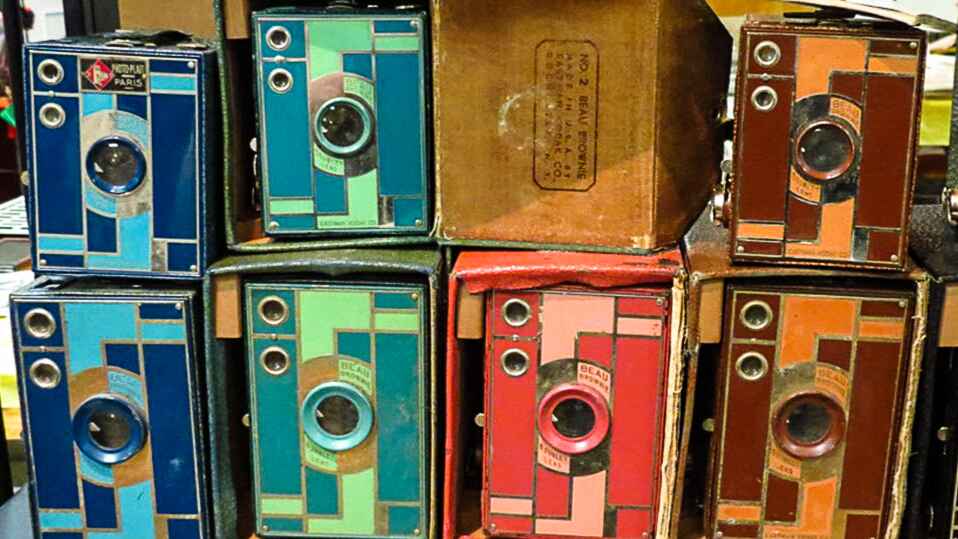
Are Those Even Cameras?!
Join the PHSNE Newsletter and learn more about photographic history and preservation. Already an expert? Come and share your collections and knowledge as we celebrate the history and advancement of photography.