Article and photographs by Larry Woods, PHSNE Board President-Elect
Univex (the Universal Camera Corporation), founded in 1932, initially specialized in inexpensive snapshot cameras, starting at 69 cents, with film costing as little as 10 cents for six exposures. Film was a key to Univex’s sales strategy. Their cameras used unique, patent-protected film rolls that no else made. The company began moving upscale in 1938, producing more sophisticated and expensive cameras. The Mercury I, from 1938, their most expensive camera to that point used 35mm film, but in unique Univex cartridges.
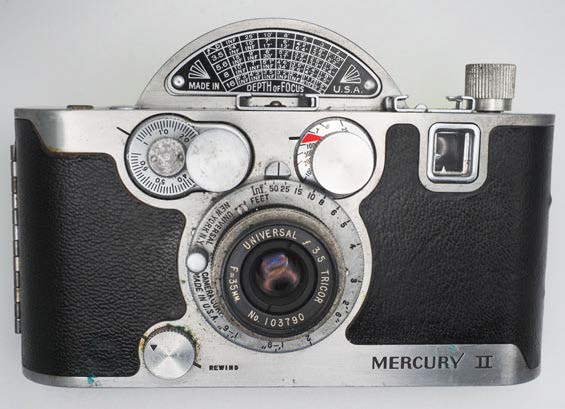
When its Europe-sourced film supplies ceased during World War II, Univex faced serious reputational and financial problems. They stopped camera production and built binoculars for the military. When camera production resumed after the war, Univex introduced the Mercury II, a half-frame 35mm camera that dates from 1945. Its basic specification is similar to the new (2024) Pentax 17. It modified its cameras to use standard film sizes, so the Mercury II uses standard 35mm cartridges, but is otherwise similar to the original model.
The most unique feature of the camera is its shutter, a design derived from movie cameras. It consists of two disks with a variable width gap between them set by the shutter speed dial. The disks spin at a constant speed. Different shutter speeds come from the size of the gap. This explains the circular extension on the top of the camera which covers the disks. The top shutter speed is 1/1000 of a second. Among contemporary cameras, only the Leica and Contax had a similar top speed, at more than four times the price. Cameras with a price similar to the Mercury II maxed out at 1/300. The lens is interchangeable. Three coated standard lenses were available, 35mm f/3.5, f/2.7, and f/2, focusing down to 18 inches, and two telephotos, a 75mm f/3.5 and a 125mm f/4.5.
The camera was assembled from die cast (as opposed to machined) aluminum alloy parts Depending on conditions for storing cameras – humidity, temperature, etc.—the metal surfaces of cameras may deteriorate, and the surfaces of Mercury II cameras tend to deteriorate more than other cameras. Most available on eBay are badly corroded.
The camera operates very similar to a more modern still film camera. To load, make sure the rewind knob (at 7 o’clock around the lens) points to 10 o’clock. The hinged back pops open with a button on the bottom of the camera. The film clips under a spring on the take-up spool. After winding the film on once or twice (with the left knob above the lens), pressing the shutter after each wind, close the back and manually turn the film counter to point to the highest marked number (65), then wind the film 4 more times. The film counter now points to 1, and you are ready to shoot.
Check or set your shutter speed (the right knob above the lens, pressing down to turn the knob), after winding the film. Set your f stop (on the f/3.5 lens it is at 3 o’clock on the lens, other lenses may vary). And finally focus by turning the distance scale with the knob shown at 9 o’clock in the picture. You are now ready to frame your picture through the viewfinder and take your shot.
To a modern film photographer, the most unfamiliar aspects are the location of the wind knob on the front of the camera, and the requirement to focus by guessing your distance and setting it on the lens. One other quirk is that the camera does not have eyelets for a neck strap. If you don’t have an “ever-ready” case made for the camera, you do without, or attach something to the tripod screw at the bottom.
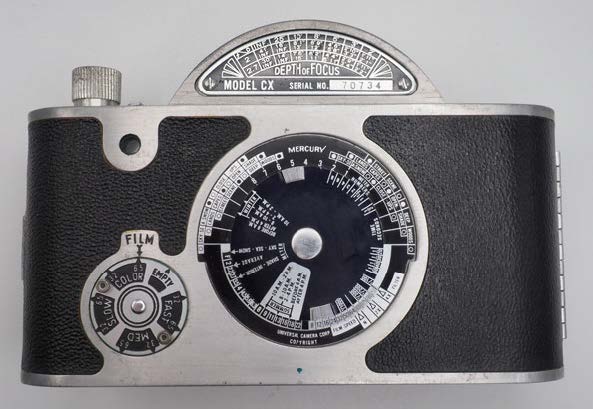
There is a complicated exposure calculator dial on the back. It has three dials, factoring together film speed, subject type, season of the year, weather conditions, and time of day into its calculations. You can ignore it and use a “Sunny 16” calculation instead.
When you have finished a roll of film (65 shots on a 36-exposure roll – the space between frames is wider than on a modern camera), turn the rewind dial to point to the word “REWIND”, and turn the rewind knob on the top of the camera until you hear the film pop from the take- up spool.
Although it has its quirks, the camera is quite usable, and is surprisingly sophisticated for its age and original price.
A Mercury II that was donated to PHSNE will be included in the Photographica 93 auction in April. It has much less corrosion than most surviving Mercury IIs, and is in prime condition for its age, with one exception: The three element lens has a crack in the rear element. No photographs from this camera were developed before this article went to print, so it is unknown how the crack would affect pictures. The camera comes with an ever-ready case with the shoulder strap intact, so would make an excellent collector’s item.
What the heck…
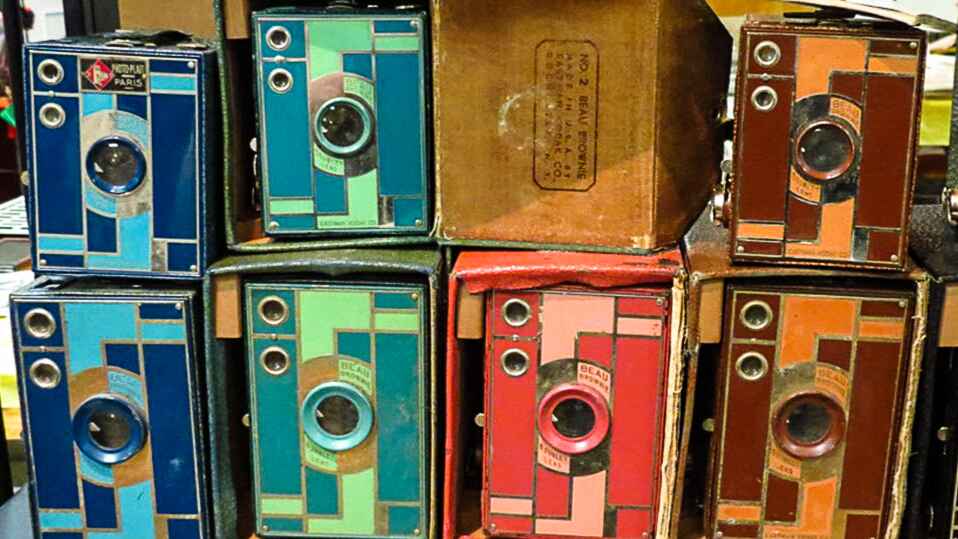
Are Those Even Cameras?!
Join the PHSNE Newsletter and learn more about photographic history and preservation. Already an expert? Come and share your collections and knowledge as we celebrate the history and advancement of photography.