By Larry Woods, PHSNE President
The high point of Polaroid’s camera development was the SX-70 camera series, a folding camera that used the newly developed integral SX-70 film. Both the film and original SX-70 camera first came out in 1972. Development costs were rumored to have been in the half billion dollar range. Integral film meant that the film ejected from the camera in one piece, without having to pull layers apart as previous Polaroid film had required, and it had a battery built into each film cartridge. In 1972, the idea of integral film was revolutionary. Today it is just the way Polaroid film works. The camera was a Single Lens Reflex, but nothing at all like a 35mm SLR, because the frame size was 77mm square, and the camera folded flat when not in use.
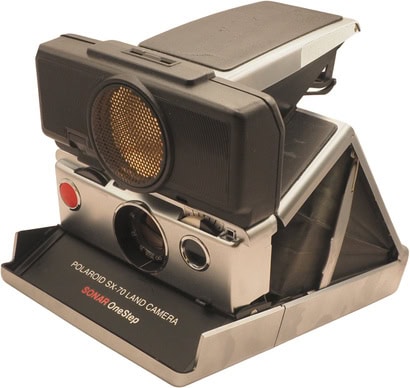
The way the camera opened was unique, due to the SLR design. You pulled up on the knurled part of the viewfinder and lifted, pulling out the bellows, until the camera locked into place. You then looked through the viewfinder, with your right hand over the shutter button. When you were ready, you just squeezed the shutter button. In the pre-Sonar version of the camera you then focused by turning a wheel above the shutter button until the image looked sharpest, then pressed the shutter. The camera set exposure, fired the shutter, and then ran a motor to push the film from the camera. The film developed outside the camera.
Some people had trouble manually focusing the original SX-70 cameras, so Polaroid developed an autofocus system that used sonar, and this camera, the SX-70 Sonar OneStep, was the result. It was released in 1978. When you pressed the shutter, the camera sent out a sonar pulse, heard the pulse echoing back, adjusted the focus and exposure, then released the shutter. At the time, there was only one other autofocus camera commercially available in the entire world, a small Konica point-and shoot 35mm. Minolta didn’t release its first autofocus SLR until 1985, Canon in 1987.
For flash, the SX-70 used a flashbar, a flashbulb array that holds 10 one-time use flashbulbs. These have not been made for years, but they can be found on markets like eBay. If you plan to use the camera much, an electronic flash would be cheaper in the long run, plus you wouldn’t have to worry about running out of flashbars. Polaroid made an electronic flash for this camera called the Polatronic 2350. If you get one, make sure you get two plastic pieces with it, One labeled 2352, and a small piece with no label. The 2352 attached to the bottom of the camera, and the other connected the flash to the 2352, mounting the flash to the camera. You can also find brand new electronic flash units brand named Mint that plug into the camera where the flashbar goes.
In the 1980s, with the development of faster “type 600” film, Polaroid replaced the SX-70 Sonar camera with a model called the SLR 680. It was essentially the same camera that accepted the new film. Other than adding a built in electronic flash, it was pretty much the same camera.
The design of the SX-70 cameras, created by Edwin Land and designed by Henry Dreyfuss and James M. Conner, fit the sleek modern vibe of the 1970s, and the camera is featured in the collections of museums and graces the shelves of camera collectors. Newly designed SX-70 film is still available. It’s a stellar example in Polaroid history, a true innovation and a New England icon.
What the heck…
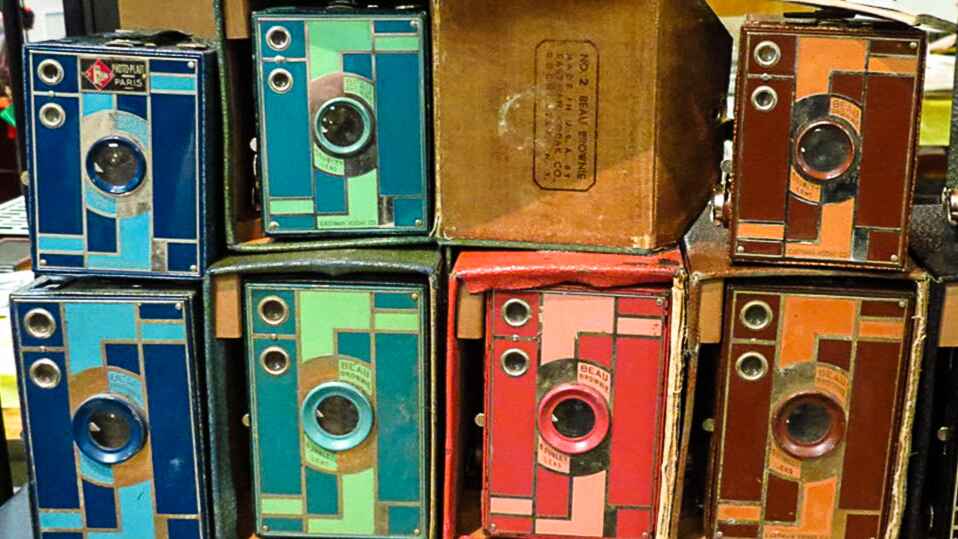
Are Those Even Cameras?!
Join the PHSNE Newsletter and learn more about photographic history and preservation. Already an expert? Come and share your collections and knowledge as we celebrate the history and advancement of photography.