By Chuck Fehl
Robot Cameras were 35mm cameras made by Otto Berning & Co. in Dusseldorf (West) Germany from the mid-1930s until the mid-1980s. The original Robot I camera designed by Heinz Kilfitt (of Kilfitt lens fame) in 1931 was the prototype that every Robot evolved from. It had three basic attributes: miniature relative size (an inch shorter than a Leica), highest quality materials and optics, and high speed clockwork film advance mechanisms. This last characteristic was what the cameras are most noted for by users (and collectors).
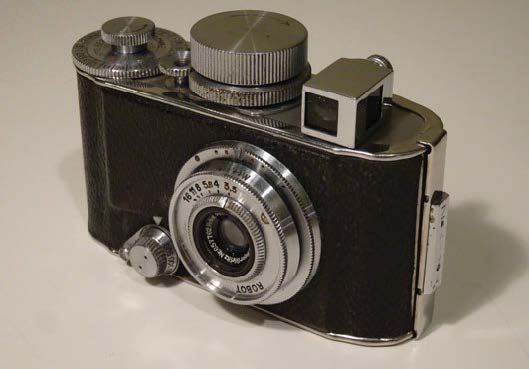
Another attribute of most Robot cameras is their almost uniquely square 24x24mm film format on 35mm cine film. Most 35mm cameras are rectangular in format – either double frame (36x24mm), or single frame (18x24mm) that produced rectangular prints by local film processing machines. The Robot’s 24×24 square format (producing square negatives and prints) had to be sent to special labs for processing, or developed at home by the photographer.
This format was defended by Robot fans as superior to conventional 35mm formats as it provided more shots than double frame cameras (50 vs. 36) and better resolution than single frame cameras with its 50% larger negative. It also provided a much deeper depth of field than double frame cameras as its normal lens was 38 or 40mm in focal length, whereas the normal lens on a double frame camera was 55 or 58mm.
This is why most Robot cameras do not have rangefinders as focusing was not critical. Instead they use a color-coded depth of field scale clearly highlighting the (in) focus range at each aperture setting. Most outdoor pictures could be taken at f8 with the lens distance set to 15 feet. Anything from 7′ to infinity was in sharp focus with its short focal length lenses. All Robot cameras had durable metal guillotine shutters with a range of ½ second up to 1/500 second.
These camera features combined to make the Robot I and all models thereafter great cameras for “point and shoot” applications where speedy work is needed. The robust spring driven clockwork motors were good for 25 to 50 pictures per wind depending on the model. Robot’s durability is demonstrated by German Luftwaffe’s use of them to record flight mission results and in training to record machine gun and bombing effectiveness. They could be hand held or gun mounted.
After WWII, Robot continued to develop and produce high quality civilian cameras through the 50’s and 60’s, but its main thrust was changing to security and industrial applications. It became increasingly hard to compete with mass produced cameras from Japan selling for a fraction of the cost of a handmade Robot Royal made in Germany with its Zeiss and Schneider optics. In the 1970’s Robot turned to traffic control and bank surveillance systems as its principal products – at first converting its civilian cameras with expansive film magazines and electric winders and remote triggers. In the early 90’s, Robot (Otto Berning & Co) was sold and changed its name a couple of times. It is now known as Robot Visual Systems Gmbh and has developed a new line of digital traffic control and security systems still sold and in use today, mainly in Europe. In Germany and elsewhere they use Robot equipment to issue automatic speeding and traffic light citations complete with your picture committing the crime. I unfortunately have one to prove it!
Excerpted with permission from MiPHS The Photogram, Vol. 49 No. 1, Winter 2020-2021. Visit the Michigan Photographic Historical Society online at miphs.org
What the heck…
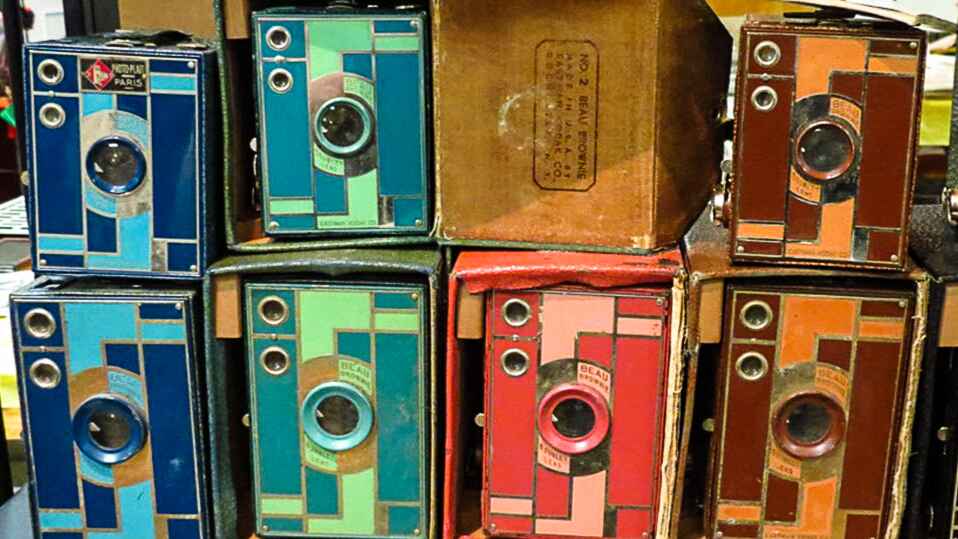
Are Those Even Cameras?!
Join the PHSNE Newsletter and learn more about photographic history and preservation. Already an expert? Come and share your collections and knowledge as we celebrate the history and advancement of photography.